
What a 0.3 mm thickness tolerance actually means for panel glue-up
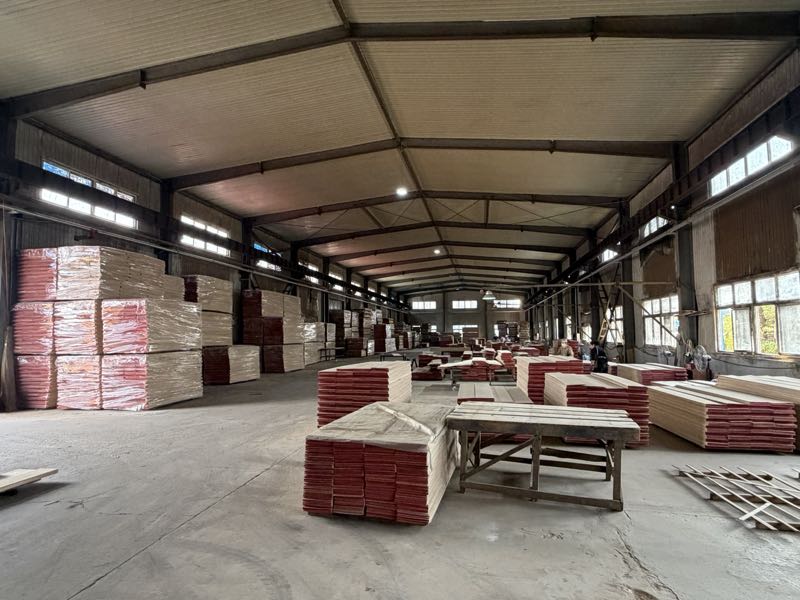
Customers ask whether the 0.2 mm between ±0.3 mm and ±0.5 mm really matters. Walk through the glue-up and it becomes clear.
What uneven thickness does
In the press the strips are held to one plane. Proud strips take the pressure; thinner strips do not get enough contact pressure on the glue line, and local delamination follows. After pressing, the whole panel has to be sanded down to the thinnest strip — so the extra material on the thick strips becomes sawdust.
The arithmetic
Say the finished panel is 18 mm and strips arrive at 20 mm. At ±0.3 mm the spread is 0.6 mm and a 1 mm sanding allowance is enough. At ±0.5 mm the spread is 1.0 mm and you need 1.5 mm to be safe. That extra 0.5 mm on a 20 mm thickness is 2.5% more loss per cubic metre — twenty-five cubic metres a year on a thousand-cubic-metre usage.
How we hold it
- Two sanding passes, measured after the coarse pass and adjusted before the fine pass;
- Strips for one order sanded in one run so batches do not drift apart;
- Three thickness readings per bundle, recorded and shipped with the goods;
- Moisture at 8%–12% so thickness does not move again in storage.